Advertisement

SEJournal Online is the digital news magazine of the Society of Environmental Journalists. Learn more about SEJournal Online, including submission, subscription and advertising information.
October 15, 2025
 |
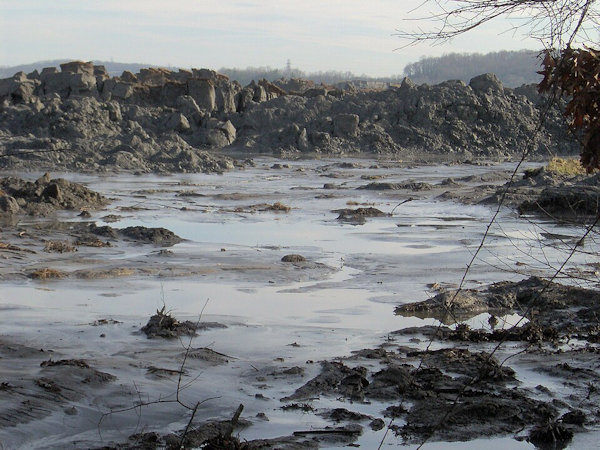 |
| A view of the 2008 Kingston, Tennessee, spill that prompted Obama-era coal ash regulations. Photo: Brian Stansberry via Wikimedia Commons (CC BY 3.0). |
TipSheet: Coal Ash Is an Issue That Just Won’t Stay Buried
By Joseph A. Davis
One of the best reasons to write local stories about coal ash right now is that the Trump administration wants to pretend it doesn’t matter and doesn’t exist. But it does.
The bad news is that coal ash is almost everywhere. There are some 700 to 1,425 massive dumps of coal ash, and they’re found in almost every state across the country.
States and utilities are doing
little or nothing to remedy the
threat that coal ash presents.
More bad news: States and utilities are doing little or nothing to remedy the threat that it presents.
The good news is that coal-fired electric power plants that generate coal ash are steadily and inevitably closing, at least in the United States.
The backstory
When coal is burned, it produces several waste byproducts.
 |
The dry ash that goes up the smokestack must, by law, be filtered for particulates in baghouses that collect “fly ash.” The unburned waste left in the furnace is called bottom ash. Other residuals come from things like water pollution control technologies.
The fancy name for all of it is “coal combustion residuals.” The common name is coal ash.
Estimates of the number of coal ash sites vary because some plants are closed, some plants have multiple disposal sites, many are still unregulated and a few are being cleaned up.
Coal ash is some (but not all) of the pollution removed from burned coal. It is mostly mineral. It contains many toxic substances, especially heavy metals like arsenic, chromium, lead and lithium. It also contains radium, which is radioactive.
These toxins leach into both ground and surface water, often contaminating drinking supplies.
Most coal ash simply accumulates in pits, ponds and lagoons near the power plant.
Why it matters
The problem is that, for decades, coal ash pits were not even regulated.
After the December 2008 Kingston coal ash spill in Tennessee, the problem could no longer be ignored. The U.S. Environmental Protection Agency, under President Barack Obama, set regulations to control it, almost — but not quite — as a hazardous waste.
Over subsequent administrations, the utility industry worked hard to water the regs down. It was a tug-of-war.
The EPA under Trump 2.0 recently
announced that it was delaying
by two years any enforcement
of the coal ash regulations.
Most recently, the EPA under Trump 2.0 announced in July that it was delaying by two years any enforcement of the coal ash regulations.
Hardly anyone noticed, amid the wide-scale degradation of all the EPA’s missions under Trump 2.0.
The upshot for now is that anything that happens will be up to the states.
So it’s a great time to find out what’s happening (or not happening) at the coal ash dumps in your audience area.
Story ideas
- How many coal ash disposal areas are there in your community? Are there coal ash sites not on an official list? Why not? Are utilities acknowledging clear responsibility for existing sites?
- Have any of the coal ash sites in your area been cleaned up to a nominal safety standard? Have they been moved to a landfill? Is it lined and capped? Safe from water? Is the new disposal site safer than the old one?
- What waters are near your area’s coal ash sites? Are they sited near a river, lake or estuary? Are they above an aquifer? Is that aquifer a drinking water source? Has anyone tested for water pollution and what were the findings?
- Historically, have there been pollution incidents in your area related to coal ash sites?
- What level of responsibility are states and utilities taking for stabilization, cleanup or maintenance of coal ash sites in your area?
- What do people in your state think about using coal ash in the concrete on local roads? Is it being done? Do people know about it?
Reporting resources
- Earthjustice: This environmental advocacy and litigation group has for years specialized in coal ash, among other issues. The best source is its maven, Lisa Evans.
- U.S. Environmental Protection Agency: The EPA is the main federal agency that is supposed to regulate and oversee coal ash dumps, to make them safer and less polluting.
- State environmental agencies: In some cases, the EPA has already devolved coal-ash cleanup responsibilities to state environmental agencies. See a list here.
- American Coal Ash Association: An industry lobby group largely aimed at lightening the coal ash regulatory burden on utilities and promoting the reuse of coal ash — and the idea that doing so is safe.
[Editor’s Note: For more on the topic, see this earlier TipSheet, plus TipSheets on how an EPA leak on problem coal ash sites could yield local drinking water stories, as well as on using coal ash data to help pinpoint local pollution stories. And for the latest coal ash-related news, see top headlines from EJToday.]
Joseph A. Davis is a freelance writer/editor in Washington, D.C. who has been writing about the environment since 1976. He writes SEJournal Online's TipSheet, Reporter's Toolbox and Issue Backgrounder, and curates SEJ's weekday news headlines service EJToday and @EJTodayNews. Davis also directs SEJ's Freedom of Information Project and writes the WatchDog opinion column.
* From the weekly news magazine SEJournal Online, Vol. 10, No. 36. Content from each new issue of SEJournal Online is available to the public via the SEJournal Online main page. Subscribe to the e-newsletter here. And see past issues of the SEJournal archived here.
SEJ Publication Types:
Topics on the Beat:
Region:
Visibility: